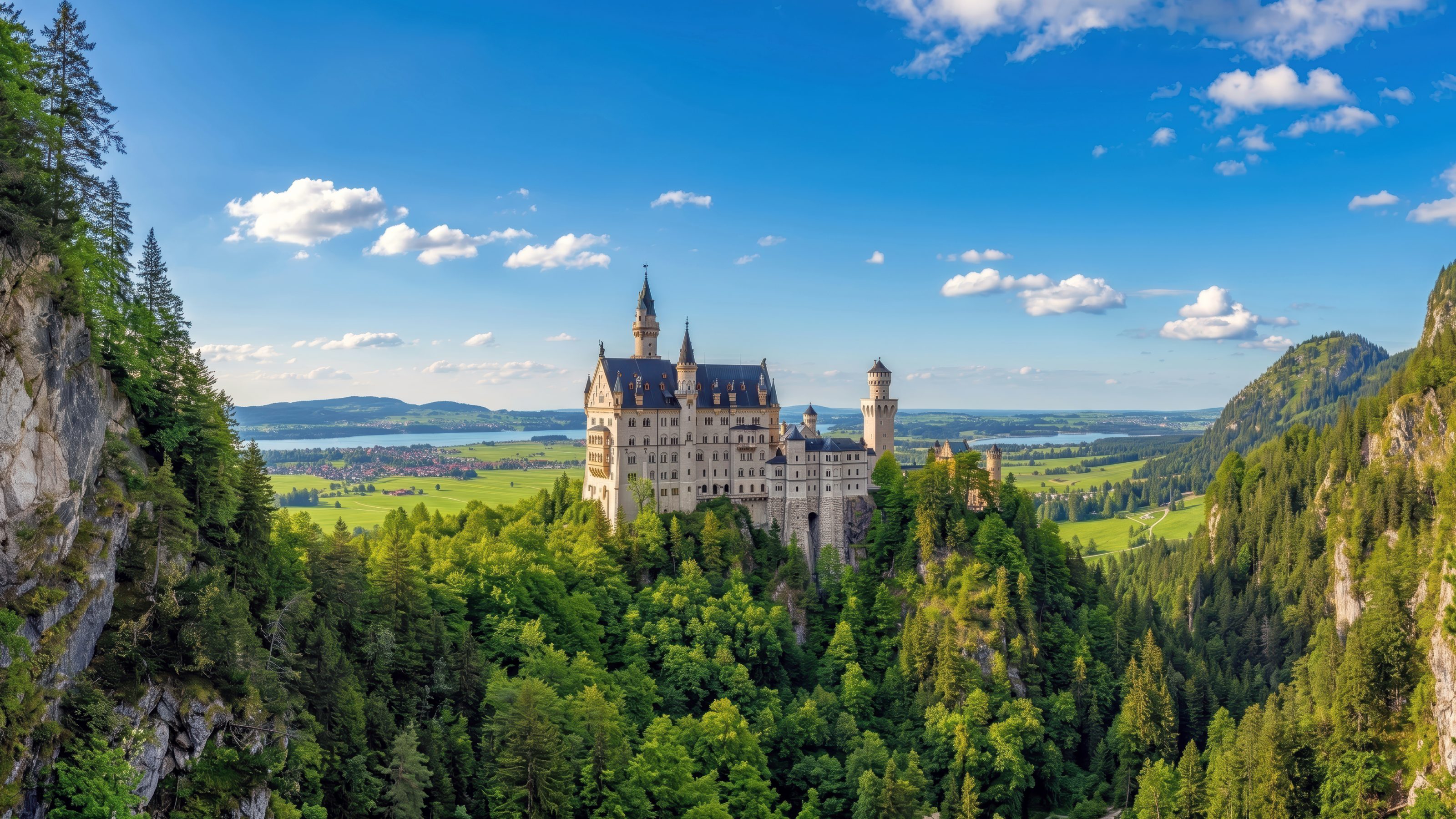
Neuschwanstein Castle from Mühlberg
From Mühlberg, Neuschwanstein Castle can be planned well as its own excursion. If you stay here, you do not have to press the castle visit into a packed schedule, but can approach it calmly.
Historically, what is especially interesting is that Neuschwanstein Castle was never intended as a medieval castle. Ludwig II planned his "New Hohenschwangau Castle" here: a personal retreat and a deliberately designed pictorial world of the 19th century. That is exactly why it is worth seeing the castle as more than a viewpoint or photo subject.
History at a glance
Neuschwanstein Castle in four points
From summer 1868
This is how the Bavarian Palace Department dates the work on the building site below today’s castle complex.
Retreat of Ludwig II
Neuschwanstein Castle was intended as a personal place of retreat, not as a stage for courtly representation.
Historicism with modern technology
Cemented foundations, brick masonry, limestone cladding and modern constructions meet medieval pictorial ideas.
Throne Hall, Singers’ Hall, Grotto
These rooms show especially clearly how closely architecture, legend and staging belong together.
From building site to famous silhouette
Work on the building site began in summer 1868, the new access road was completed in June 1869, and the foundation stone was laid on September 5, 1869. The first part to be built was the Gatehouse, which was ready for occupancy at the end of 1873 and served Ludwig II as an apartment for years.
From September 1872, the Palas rose upward; the topping-out ceremony was on January 29, 1880. By mid-1884, the technical and artistic fittings were largely complete, so Ludwig II could use the castle. Nevertheless, Neuschwanstein Castle was never completed. The name that seems natural today only became established after the king’s death.
Seven weeks after Ludwig’s death, the castle was opened to the public in 1886. Since 2025, Neuschwanstein Castle has been part of the serial UNESCO World Heritage Site of the Castles of King Ludwig II. For guests in Mühlberg, this is useful background knowledge, but the excursion itself remains the focus.
What helps with planning
The interior can only be visited as part of a guided tour. For that reason especially, it is worth not scheduling the day too tightly. If you stay in Mühlberg, you can approach the castle visit more calmly and still have time afterwards at Alpsee or in the holiday apartment.
That is one advantage of the location: a very well-known destination in the region is close by, without the whole stay having to revolve around one programme point.
Interiors and pictorial worlds
Anyone taking a guided tour sees the rooms in a fixed order. What stands out is how consistently Ludwig II had individual halls designed as pictorial worlds around medieval themes. The Throne Hall is not a representative audience hall in the usual sense, but was designed after the model of a legendary Grail hall. Structurally, it is a clad steel construction behind a stone shell.
The Singers’ Hall takes up the entire fourth floor of the eastern Palas wing and was one of the king’s favourite projects. Its pictorial programme does not mainly show the famous singing contest, but the Parzival material and ends with his son Lohengrin, the "Swan Knight". This creates a thread running through the whole castle: Tannhäuser, Lohengrin and Parzival are the central figures of the decoration.
Interiors at a glance
Four rooms from the tour
Throne Hall
Built as a clad steel construction and designed after the image of a legendary Grail hall, not as an audience room.
Singers’ Hall
Extends across the entire fourth floor of the Palas. The picture sequence is mainly dedicated to the Parzival and Lohengrin material.
Artificial grotto
On the fourth floor, an artificial grotto with winter garden adjoins the living rooms, a space with its own mood.
Study and living room
The study shows the life story of the minnesinger Tannhäuser; the Lohengrin cycle continues in the living room.
Getting to the castle
By car, you drive to Hohenschwangau, not to the castle. Paid parking lots P1 to P4 are located in the valley; private cars are not allowed farther up. From the valley there are three routes to the castle: on foot via Schlossstraße, by shuttle bus or by horse-drawn carriage. None of these routes ends directly at the castle entrance.
The shuttle bus starts at parking lot P4 and goes uphill to the Jugend viewpoint at Marienbrücke. From there it is a short downhill walk to the castle. The horse-drawn carriage runs from the valley to near the castle; from the drop-off point there are still a few minutes uphill on foot. According to official information, the walk from the Ticket Center to the castle takes about 40 minutes and is continuously uphill. For guests in Mühlberg, the drive to Hohenschwangau is short, so the ascent does not have to become the bottleneck of the day.
Tickets and time slots
The castle visit is only possible as part of a guided tour at a fixed admission time. Tickets are available either in advance in the official online shop at hohenschwangau.de or on the same day at the Ticket Center Hohenschwangau on Alpseestraße, subject to availability. An admission ticket is valid for a specific time, not for flexible entry.
In practice, this means: if you want certainty, book online in advance. If you plan spontaneously, you should stop by the Ticket Center in the morning and allow for the fact that only remaining tickets for the same day are issued. Enough time for the ascent must be planned between buying tickets in Hohenschwangau and admission at the castle.
Also relevant: the article on Hohenschwangau, Alpsee and museum and the overview Surroundings from Mühlberg.