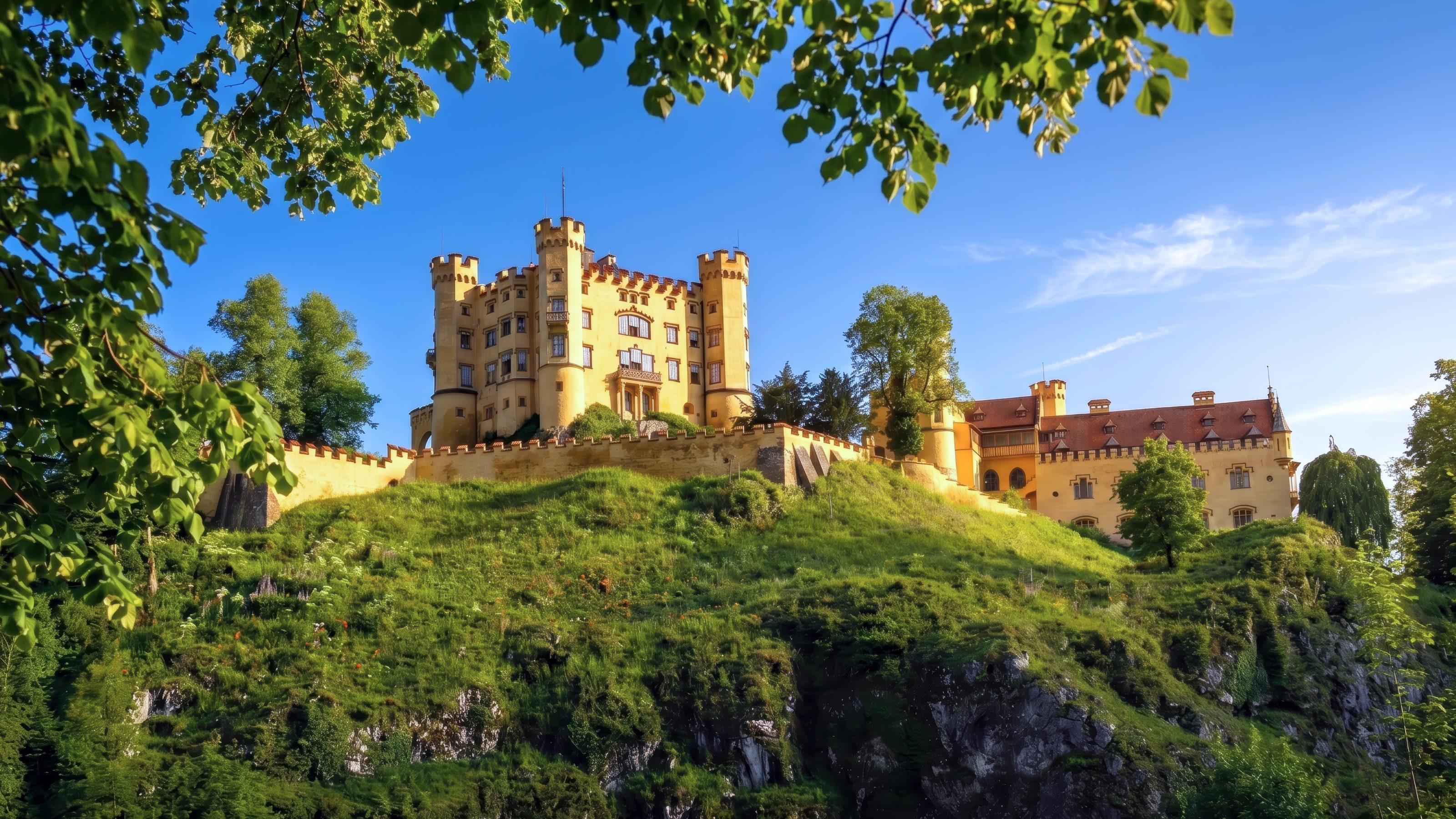
Hohenschwangau: castle, Alpsee and museum
Hohenschwangau lies above Alpsee and can be included well from Mühlberg in a half-day or full-day excursion.
Unlike Neuschwanstein Castle, Hohenschwangau is clearly readable as the residential castle of the royal family. That is exactly what makes the visit interesting if you want to understand the region not only through images but also through its history.
History at a glance
Hohenschwangau in four points
Roots in the 12th century
The documented history of the former Schwanstein Castle reaches back this far.
Redesigned from 1833 to 1837
Under Domenico Quaglio, the ruin became the romantic castle seen today.
More than 90 wall paintings
According to the official account, interior and exterior design form a deliberately connected whole.
Summer and hunting residence
For generations, Hohenschwangau was an actual residence of the Bavarian royal family.
From Schwanstein Castle to residential castle
The former Schwanstein Castle was first mentioned in documents in the 12th century and remained in the possession of the Knights of Schwangau until 1535. After later changes of ownership, the complex was badly damaged in the Napoleonic Wars.
In 1829, Crown Prince Maximilian of Bavaria discovered the ruin and acquired it in 1832. Under the direction of Domenico Quaglio, today’s romantic castle in neo-Gothic style was created between 1833 and 1837. The royal family then used Hohenschwangau as a summer and hunting residence.
Because Ludwig II spent his childhood here, Hohenschwangau is more than a prelude to Neuschwanstein Castle. The official account explicitly connects this place with his early impressions of mountain scenery, castle romanticism, legends and medieval pictorial worlds.
Add the castle garden and museum
Hohenschwangau also includes a castle garden with views of Alpsee, forests and mountains. That alone often makes the visit feel calmer: the experience does not happen only indoors, but also around the castle. Officially, the castle is shown only as part of a guided tour.
If you want to go deeper, the day can be complemented well with the Museum of the Bavarian Kings. The museum opened at Alpsee in 2011, includes 16 exhibition rooms on two floors and tells the history of the Wittelsbach dynasty from its beginnings to the present. A particular focus is on Maximilian II, Hohenschwangau and Ludwig II.
For guests in Mühlberg, this combination is practical: first castle and museum, later quiet again in the holiday apartment.
Rooms and their pictorial worlds
The castle rooms are named after the themes shown in their wall paintings. This is more than a decorative detail: anyone who knows the rooms better understands which pictorial worlds surrounded Ludwig II every day from childhood.
The Swan Knight Hall served as dining room and shows the legend of Lohengrin, the Swan Knight. The Hohenstaufen Room is devoted to the Staufer imperial dynasty; the room was also Ludwig II’s dressing and music room. The Tasso Room, the royal bedroom, is named after the Italian poet Torquato Tasso and takes up motifs from his epic "Jerusalem Delivered". The Berchta Room, finally, tells Bavarian legends of Charlemagne and his mother Berchta. There are also other rooms such as the Welf Room and the Knights’ Hall with images from the Dietrich legend.
This combination explains why the castle is described in official accounts as a coherent pictorial programme. Legend, history and poetry interlock room by room.
Details at a glance
Four details of the interiors and grounds
Wagner connection in the music room
The Hohenstaufen Room contains the piano on which Richard Wagner is said to have played during his stays.
Lohengrin in the dining room
The Swan Knight Hall shows the Lohengrin legend and shaped Ludwig II already as a child.
Tasso Room as bedroom
In the Tasso Room, scenes from "Jerusalem Delivered" decorate the walls, complemented by a starry sky on the ceiling.
Castle garden with references
The castle garden was revised in 2007 under monument conservation requirements; fountains take up motifs from the interiors.
Arrival, ascent and carriage
There are several paid parking lots in the valley of Hohenschwangau (P1 to P4). They are the last parking option before the castle; you cannot drive farther up by car. From the valley to the castle, a continuously asphalted footpath of around 1.5 kilometres leads uphill. It climbs steadily, but is nowhere extremely steep. At a normal pace, the ascent takes about 20 to 30 minutes.
If you do not want to walk up, you can take a horse-drawn carriage. For space reasons, the carriages do not go all the way to the castle, but stop below it at the castle restaurant. From there, it is still around 450 metres uphill on foot. The carriage is therefore not a real shortcut; it is more of a help if the first part of the route is difficult.
Inside, the castle is shown only as part of a guided tour. If you travel from Mühlberg, you can use the short distance and arrive in a way that leaves time before the assigned admission for the ascent and a calm view from the forecourt.
Tickets, reservation and day planning
Tickets for Hohenschwangau are available only through the official online shop and at the Ticket Center Hohenschwangau in the valley. Telephone or written reservations outside this route are not provided. On site, subject to availability, only tickets for the same day are sold. In high season, these remaining quotas are often gone early in the morning.
Advance booking through the online shop is therefore sensible. Each admission is tied to a fixed entry time, so the ascent from the valley to the castle should be planned generously. If you want to combine Hohenschwangau and Neuschwanstein Castle, you can buy a joint combination ticket; both castles are then visited on the same day, each with its own admission time. The Museum of the Bavarian Kings at Alpsee is also included in combination offers.
For Mühlberg guests, this has a practical advantage: because the drive is short, admission times can be chosen flexibly without scheduling the day tightly. If you want to see both castles in one day, plan several hours according to the official recommendation and let the rest of the day end quietly in the holiday apartment or at Alpsee.
For further planning, the article on Neuschwanstein Castle and the overview Surroundings from Mühlberg fit well.